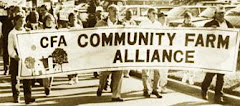
With the 2008 Legislative Session of the Kentucky General Assembly all wrapped up, CFA can't help but celebrate. After a long and interesting few months, we are grateful that BOTH our pieces of legislation have been signed by the presiding legislative officers and sent to Governor Beshear for his signature! Congratulations and Thank You to all those members who helped CFA lobby for these legislative victories! Your hard work and dedication as well as your emails, phone calls, and personal visits to legislators made this session a successful one for CFA and for Kentucky's family farmers, proving that Real Change Comes From the Ground Up!
Special thanks go to Representative Dwight Butler and his intern Brittany Dowell for their inspiring work on HB 484, as well as to co-sponsors Rep. Charlie Hoffman, Tom McKee, C.B. Embry and Jeff Greer.
A world of gratitude to Rep. Rick Rand, Johnny Bell, and Jeff Greer for the success of HB 495! Thank you for being true champions for Kentucky's family farmers!
HB 495: Limits the Implementation of the National Animal Identification System in Kentucky.
Sponsor: Representative Rick Rand
Co Sponsors: Representative Johnny Bell and Representative Jeff Greer
What Will House Bill 495 Do?
· HB 495 prohibits the state of Kentucky from mandating the National Animal Identification System in the absence of a federal law requiring compliance with the USDA program. In the event that NAIS does become mandatory at the federal level, HB 495 ensures that Kentucky's compliance can be no more stringent than federal policies.
· HB 495 also prevents the state from penalizing any farmer or withholding goods, services, licenses, permits, grants or other benefits based on non-participation in any phase of the National Animal Identification System.
What House Bill 495 Does NOT Do:
· HB 495 does not prevent Kentucky from establishing or participating in disease control programs specifically designed to address a known disease in a specific species of livestock.
· HB 495 does not prohibit private agricultural industry organizations from establishing voluntary source verification programs for their own members or others who elect to participate.
Why is This Necessary?
Though NAIS is currently voluntary and expected to remain voluntary at the federal level, USDA is funding state departments of agriculture that agree to implement the program. Kentucky has recently been promoting the program and requiring participation in certain phases of the system to qualify for certain services. HB 495 will stop us from going any further. Until USDA can get the program mandated, Kentucky should back away from it also, for the sake of our family farmers. The program is intrusive, costly, and burdensome to the family farmer and tilts the scales heavily in favor of corporate agribusiness. HB 495 is the necessary step to stop N.A.I.S. in Kentucky!
What Happened with HB 495?
HB 495 passed unanimously out of the House Agriculture Committee, unanimously off the House floor with a vote of 95-0. The bill passed unanimously out of the Senate Agriculture committee, and unanimously off the Senate floor. It has now been delivered to Governor Beshear where it awaits his signature.
John Logan Brent, Henry County Judge Executive and Beef Cattle Producer
"I am very appreciative of my Representive Rick Rand for sponsoring this bill and for Community Farm Alliance and all of there hard work in seeing it through. Our legislature got this one right. HB 495 is a common sense bill designed with the farmer in mind, not the corporation and that is definately refreshing in today's Agriculture."
Steve Smith, CFA member and farmer in Trimble County
"This bill is a true victory for our family farms. Special thanks go to Representatives Rick Rand and Johnny Bell, and to the people of Community Farm Alliance for all of their hard work for farmers in Kentucky on this issue."
HB 484 – Local Food for State Universities
Sponsor: Representative Dwight Butler
Primary Co Sponsor: Representative Charlie Hoffman
Other co-sponsors: Representative Tom McKee, Representative C.B. Embry, Representative Jeff Greer
What Will House Bill 484 Do?
HB 484 amends KRS 164A.575 to require state funded universities to purchase agriculture products from local producers.
Why is This Necessary?
This legislation partnered with HB 669 from the 2006 legislative session ensures that Kentucky institutions are supporting a local farm economy and secures yet another market venue for Kentucky's family farmers. Now, not only will patrons of Kentucky's state parks and institutions be eating locally grown, so will our state universities' faculty, staff, and students!
Whats Happened with HB484?
HB 484 passed unanimously out of the House Ag Committee and out of the House of Representatives. It was sent to the Senate Education Committee, rather than the Senate Agriculture Committee, where it was met by Senator Ken Winters who would not agree to hear the bill unless it was amended to be an encouragement for universities to purchase Kentucky grown agriculture products rather than a mandated requirement. The bill then passed unanimously out of the Senate Education Committee with the Committee Substitute. Though the committee substitute reduced the bill to an encouragement rather than a mandate, it still contained a requirement for all food service contracts entered into by a university with a food service distributor to contain the purchase of Kentucky grown agriculture products. After two readings on the Senate floor, one shy of passage, Senator Brett Guthrie added a Senate Floor Amendment that removed that requirement, gutting the bill to a simple encouragement.
Brittany Dowell, Legislative Intern for Rep. Butler and student at the University of Kentucky studying political science, also a member of Community Farm Alliance.
"Representative Butler and I were disappointed by the Senate floor amendment, but we have been encouraged by the Community Farm Alliance's commitment to enforcing the legislation and holding Universities accountable."
Commissioner of Agriculture Richie Farmer
“This bill will provide another market for Kentucky farmers to sell their Kentucky Proud products,” Commissioner Farmer said. “This will create economic activity in many rural Kentucky communities and help keep farmland in agriculture. "
Monday, April 07, 2008
Kentucky General Assembly Helps CFA, Local Farmers, Create L.I.F.E.
Friday, March 14, 2008
Legislative Update and Call to Action
First the good news:
HB 484 Passed the Senate Education Committee yesterday with a unanimous vote and has been sent to the consent calendar for approval on the Senate Floor! Thank you to all those who called and lobbied to help us achieve this great victory for Kentucky farmers! Congratulations to Betty Bailey, CFA board member from Bath County and 4th generation family farmer, who shined like a star in her testimony in front of the committee!
We'll keep you posted on what happens on the Senate Floor!
And now the not so good news:
HB495 is in trouble in the Senate! In order to get through the Senate, the bill must be heard by the Senate Ag Committee, who has not yet agreed to put the bill on their agenda for a vote!
CFA NEEDS YOU!
WE NEED ALL THE CALLS WE CAN GET TO CHAIRMAN JENSEN! We are hoping to convince him to put it on the agenda for next Thursday's Ag Committee meeting, as after next week time will start to quickly run out on the session.
TAKE ACTION!
Leave a message for the entire Senate Ag Committee
Leave a message for Senator Jensen
If your Senator is on the Ag Committee, call and personally ask them to VOTE YES and ask them to ENCOURAGE JENSEN TO PUT THE BILL ON THE AGENDA!
Senate Agriculture Committee
Estill, Jackson, Laurel, Menifee, Powell
606-878-8845
Sen. David Boswell (D)
Daviess, McLean
270-771-4921
Sen. Ernie Harris (R)
Carroll, Henry, Jefferson, Oldham, Trimble
502-241-8307
Sen. Dan Kelly (R)
Marion, Mercer, Nelson, Taylor, Washington
859-336-9048
Sen. Bob Leeper (I)
Ballard, Marshall, McCracken270-554-2771
Sen. Vernie McGaha (R)
Adair, Casey, Pulaski, Russell
270-866-3068
Sen. Joey Pendleton (D)
Christian, Logan, Todd
270-885-1639
Sen. Dorsey Ridley (D)
Caldwell, Crittenden, Henderson, Livingston, Union, Webster
270-826-5402
Sen. Richie Sanders (R)
Allen, Barren, Edmonson, Green, Metcalfe, Simpson
270-586-5473
Sen. Ernesto Scorsone (D)
Fayette
859-254-3681
Sen. Brandon Smith (R)
Bell, Harlan, Leslie, Perry
606-436-4526
Sen. Damon Thayer (R)
Grant, Kenton, Owen, Scott
859-621-6956
THANK YOU FOR YOUR SUPPORT OF KENTUCKY'S FAMILY FARMERS!
Friday, February 29, 2008
Thank You and Keep It Up!
HB 484 and HB 495 Pass House and Head to Senate!
THANK YOU to all the CFA members and friends who made calls to Representatives asking for support of HB 484 and HB 495! Both bills passed on the House Floor Wednesday!
On to the Senate!
Please make sure to call your Senators and ask them to support our bills! We should be in front of the Senate Ag Committee within 2 weeks and need to get those calls going NOW!
Ways to Help:
1. Come to Frankfort and help us lobby!
For more information contact Kaycie Len at the Frankfort office 502.223.3655
2. Call the LRC Message line and leave a message for the Senate Ag Committee asking them to VOTE YES on HB 484 and HB 495!
1-800-372-7181
3. Call your Senator and ask them personally to VOTE YES on HB 484 and HB 495!
To find your Senator's contact information visit www.lrc.ky.gov "Who's my Legislator"
Tuesday, February 26, 2008
Premiere of CFA’s new short film, "L.I.F.E.’s Lessons," at Derby City Espresso on March 6th
Community Farm Alliance invites the public to the world premiere of L.I.F.E.’s Lessons, a new short film showcasing CFA’s work in bringing fresh, local food into Louisville’s food deserts, on Thursday, March 6th from 7-9 PM at locally-owned Derby City Espresso, located at 331 East Market Street in downtown Louisville. There is a sliding scale of $5-$30 for admission, which includes a year’s membership to CFA. CFA is a statewide grassroots membership organization working on, among other things, connecting small family farmers in Kentucky with urban markets.
“This new video is about food justice, and giving all of Louisville’s citizen’s equal access to fresh, local food,” says Bill Huston, a CFA leader and partner in Urban Fresh, a business initiative to get fresh local food to residents of West Louisville and east Downtown, two of Louisville’s food deserts. “It is the story of L.I.F.E.- a locally integrated food economy - and how CFA farmers and urban residents are working together to bring health, wealth, and safe “real” food into Kentuckians’ kitchens.”
Mr. Huston is referring to the fact that many of Louisville’s citizens live in neighborhoods where they cannot access fresh food within walking distance of their homes, and do not own vehicles to drive to other neighborhoods. Instead, they are relying on either fast food, or people who can transport them to other neighborhoods’ stores. CFA, in partnership with other organizations, has initiated a movement to change that, first, by helping create Grasshoppers Distribution, LLC, Louisville’s first farmer-owned, all local food distributor, and Urban Fresh.
Ivor Chodkowski, CFA board member and owner of Grasshoppers Distribution, LLC, continues, “This month, this country experienced one of the biggest recalls of beef ever in the history of modern agriculture. The global food system is broken. With a locally integrated food system, consumers get to know and trust the farmers who produce their food, local businesses prosper, and everyone in Kentucky wins.”
Both Mr. Huston and Mr. Chodkowski are featured in L.I.F.E.’s Lessons, a short film that allows residents of Louisville’s food deserts, and Kentucky farmers, to speak for them selves about the ill health effects experienced in the food deserts, such as diabetes, high blood pressure and obesity. They also discuss why they see a local food system as their only chance for a positive solution.
Another person featured in the film, California neighborhood resident Dorcilla Johnson, continues, “We at CFA are firm believers that those who experience the challenges, own the solutions. The people interviewed in the film are all participants in the grassroots organizing that is needed to fix the problems in our local food system.”
Adam Barr, CFA board member, and a young farmer who participates in the Smoketown Farmers Market adds, “This is a great time for the public to get involved in helping us recreate our own food system. There are all kinds of ways to plug in: organizing the neighborhoods around our two low-income farmers markets, working on our new community kitchen project, and continued lobbying of local officials for support. CFA wants you all to come out to Derby City Espresso, enjoy the film, drink up some locally-roasted coffee drinks, and become part of an active network of great people who get things done, and have fun doing it.”
Monday, February 18, 2008
Legislative Call to Action!
CFA NEEDS YOU! COME TO FRANKFORT WEDNESDAY OR CALL YOUR LEGISLATORS TODAY!
HB 484 and HB495 will both be heard in the House Agriculture Committee Meeting this Wednesday February 20th at 8:00am in the Capitol Annex building here in Frankfort. If you would like to come and show your support by helping us fill the meeting room, please be at the CFA Office at 7:30am Wednesday morning!
If you can't make it to Frankfort on Wednesday, PLEASE CALL YOUR REPRESENTATIVES TODAY!
HB 484 – Local Food for State Universities
Sponsor: Representative Dwight Butler
Primary Co Sponsor: Representative Charlie Hoffman
What Will House Bill 484 Do?
HB 484 amends KRS 164A.575 to require state funded universities to purchase agriculture products from local producers.
To view a copy of the bill, go to: www.lrc.ky.gov
Why is This Necessary?
This legislation partnered with HB 669 from the 2006 legislative session ensures that Kentucky institutions are supporting a local farm economy and secures yet another market venue for Kentucky's family farmers. Now, not only will patrons of Kentucky's state parks and institutions be eating locally grown, so will our state universities' faculty, staff, and students!
HB 495: No N.A.I.S. in Kentucky!
Sponsor: Representative Rick Rand
Primary Co Sponsor: Representative Johnny Bell
To view a copy of the bill, go to: www.lrc.ky.gov
What Will House Bill 495 Do?
· HB 495 prohibits the state of Kentucky from mandating the National Animal Identification System in the absence of a federal law requiring compliance with the USDA program. In the event that NAIS does become mandatory at the federal level, HB 495 ensures that Kentucky's compliance can be no more stringent than federal policies.
· HB 495 also prevents the state from penalizing any farmer or withholding goods, services, licenses, permits, grants or other benefits based on non-participation in any phase of the National Animal Identification System.
What House Bill 495 Does NOT Do:
· HB 495 does not prevent Kentucky from establishing or participating in disease control programs specifically designed to address a known disease in a specific species of livestock.
· HB 495 does not prohibit private agricultural industry organizations from establishing voluntary source verification programs for their own members or others who elect to participate.
Why is This Necessary?
Though NAIS is currently voluntary and expected to remain voluntary at the federal level, USDA is funding state departments of agriculture that agree to implement the program. Kentucky has recently been promoting the program and requiring participation in certain phases of the system to qualify for certain services. HB 495 will stop us from going any further. Until USDA can get the program mandated, Kentucky should back away from it also, for the sake of our family farmers. The program is intrusive, costly, and burdensome to the family farmer and tilts the scales heavily in favor of corporate agribusiness. HB 495 is the necessary step to stop N.A.I.S. in Kentucky!
What Can You Do? TAKE ACTION!
Contact your legislators today! Ask them to vote yes on HB 484 and HB495!
To find your legislator’s contact information, visit the LRC website at: www.lrc.ky.gov
Call the LRC message line to leave a message of support for your legislator: 1.800.372.7181
Urge your legislators to support Kentucky’s diversifying family farmers.
Tuesday, February 12, 2008
Final Chance for Farm Bill Reform
The Farm Bill is undergoing a final revision before it goes to the White House. With the Bush administration’s stance against taxes and “budget gimmicks,” the Congressional Conference Committee is scrambling to secure funding for crucial environmental and nutrition programs in the Farm Bill. This moment in the process offers us a final chance to push for positive reform.
Conservation, rural development and nutrition programs are in jeopardy. To help reduce environmental degradation, strengthen rural communities, feed the hungry and address rising diet-related health concerns these programs must be fully funded. Establishing payment caps (similar to Dorgan-Grassley) of commodity subsides would provide the needed funding for these programs.
Commodity subsidies are government payments that go to a narrow list of “program crops” (wheat, corn, cotton, rice and soybeans) and are mostly awarded to the largest farms in the United States. Reforming the commodity subsidy system would benefit many small, diversified family farms here in the U.S. and also reduce the amount of “dumping” of cheap commodities on poor countries, which devastates farmers abroad. Very few farmers profit from commodity subsidies, but everyone would benefit from an increase in funding to programs that help to improve the health of the environment, rural communities and families.
Small farmers have been chronically underserved or discriminated against by U.S. farm policy, especially minority and limited-resource farmers. This is why we are asking Senator McConnell to support an increase in funding - at least $10 million a year in mandatory funding - for Section 2501 of the Farm Bill. Producers of color are essentially shut out from U.S. farm programs due to a system that favors large-scale commodity crop and livestock producers. An increase in this funding would afford minority farmers better opportunities and help to level the playing field.
Make a Phone Call: Sen. McConnell’s Office – (202) 224-2541
Fax a Letter: Sen. McConnell’s Fax – (202) 224-2499
Send an Email: mcconnell@senate.gov
1. Fully fund conservation, rural development and nutrition programs.
2. Establish commodity subsidy payment caps.
3. Secure $10 million annual mandatory funds for minority farmers through Section 2501.
Tuesday, December 18, 2007
Beyond the farm bill
Progressive urban food bills could help reshape America's food future
The following is an essay by Christopher D. Cook, author of Diet for a Dead Planet: Big Business and the Coming Food Crisis. His work has appeared in The Nation, Harper's, The Economist, The Christian Science Monitor and Mother Jones.
-----
After many legislative hiccups along the way, Congress is rapidly deciding the fate of America's food supply: what's grown, how it's produced and by whom, and how that food will affect our health and the planet. The roughly $288 billion Farm Bill, covering everything from urban nutrition and food stamp programs to soil conservation and farm subsidies, will dictate much about what we eat and at what price, both at the checkout line and in long-term societal costs.
And if agribusiness lobbies keep getting their way, as they've largely done in this year's Farm Bill battles, the "food bill" we all pay will be astronomical -- not just the cost of the Farm Bill itself, but the hidden costs of a taxpayer-subsidized industrial food system that causes profound harm to public health and the environment, as well as to farmers and workers.
Despite valiant progressive efforts that may bring some change at the margins, the big picture is not pretty: increasingly centralized power over food, abetted by lax antitrust policies and farm subsidies that provide the meat industry and food-processing corporations with cheap raw ingredients; huge subsidies for corn and soy, most of which ends up as auto fuel, livestock feed, and additives for junk food, fattening America's waistlines while soiling the environment; and, despite organic food's rising popularity, a farming system that's still heavily reliant on toxic pesticides (500,000 tons per year), which pollute our waterways and bloodstreams while gobbling up millions of gallons of fossil fuel. As a nation we consume (quite literally) some 100 billion gallons of oil annually in the making and long-distance transport of our food supply.
Closer to home, despite annual crop surpluses and the dumping of cheap excess supplies onto foreign markets, residents in poor urban areas are deprived of fresh, nutritious food. These so-called "food deserts" -- whose only gastronomic oases are fast-food joints and liquor marts -- feature entire zip codes devoid of fresh produce.
Government studies show this de facto food segregation leads to serious nutritional deficits -- such as soaring obesity and diabetes rates -- among poor people. And in the countryside, taxpayer subsidies directed mostly to large-scale growers and agribusiness are plowing smaller farmers out of business at a rate of one every half an hour, creating individual misery and community-wide economic havoc.
What's to be done? Congress (particularly the Senate, where debate currently resides) needs to hear Americans -- urban and rural alike -- demand serious change, to shift our tax dollars ($20 billion to $25 billion a year in farm subsidies alone) toward organic, locally oriented, nutritious food that sustains farming communities and consumer health.
Investing our tax dollars in food isn't the problem; instead of commodity subsidies that ultimately benefit the production of meat and fattening processed foods by a handful of corporations, we need a New Deal for food that reinvests funds in sustainably grown, healthful produce grown by a diversity of farmers.
Even as the congressional Farm Bill battles grind toward a mostly disconcerting conclusion, it's not too soon to look beyond this omnivore's omnibus, and begin considering a national movement of progressive urban food bills.
Cities and states have enormous purchasing power and are slowly taking the lead: San Francisco's Department of Public Health is devising sustainable procurement policies to buy more local and organic produce; some city and state food policy councils, such as Minnesota's, are helping smaller organic farmers survive by linking them up with urban markets; and the California Assembly last year passed a pilot measure to help develop new fresh produce markets in poor neighborhoods.
Change is coming piecemeal on the local level, and needs a serious booster shot. A movement of progressive urban food bills could help galvanize and expand local efforts and create a new food infrastructure that truly sustains our health, ecologies and economies -- and could help buck the trend toward increasingly monopolistic supermarkets that eschew poor districts and shut out small farmers and food companies. For starters, such a measure could include:
- Organic and local-first food-purchasing policies requiring city agencies, local schools, and other public institutions, such as county jails and hospitals, to buy from local organic farms when possible.
- Incentives -- backed by public education, expanding markets, and consumption of local organic foods -- to encourage nonorganic farmers to transition to sustainable agriculture, while subsidizing affordable prices for consumers. Ultimately this could build momentum for national subsidies for sustainable organic farming.
- Healthy-food-zone programs with carefully targeted grants that encourage small businesses and farmers' markets to expand access to healthy foods in poor neighborhoods identified as deserts. Such measures would simultaneously boost markets for area growers while, over time, radically improving public health.
- City-sponsored education campaigns discouraging obesity-inducing fast food while promoting farmers' markets and other healthful alternatives, such as an accessible directory of stores featuring regional organic products.
- Zoning, targeted water subsidies and other incentives for small-scale urban and suburban farming. American cities have agencies and budgets for everything from trash collection and wastewater treatment, to public health and the environment -- yet few dedicate serious planning and money toward ensuring that its residents eat well.
But with ample pressure from urban and rural consumers, farmers, public health experts, antihunger activists, environmentalists, and others, cities can create model food bills that build a policy-driven grassroots alternative to our industrial food system. No better time than now to start showing Congress how it ought to be done.